Dwamu
BRANDING & MARKETING
UX/UI DESIGN
WEB DESIGN
CONTENT STRATEGY
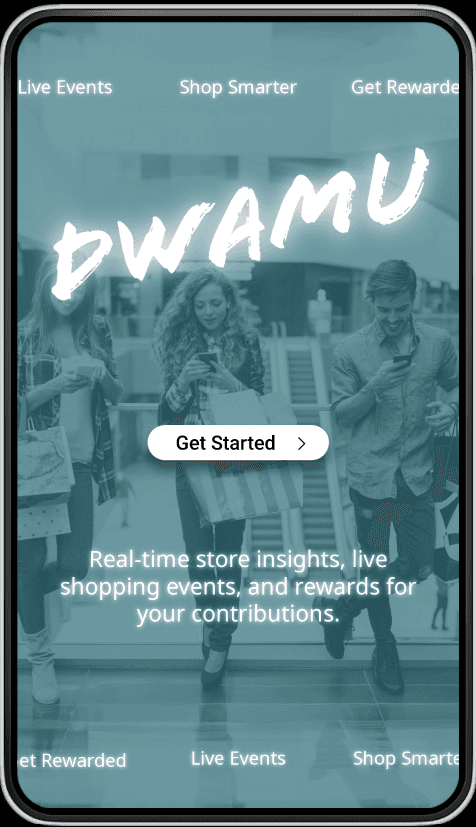
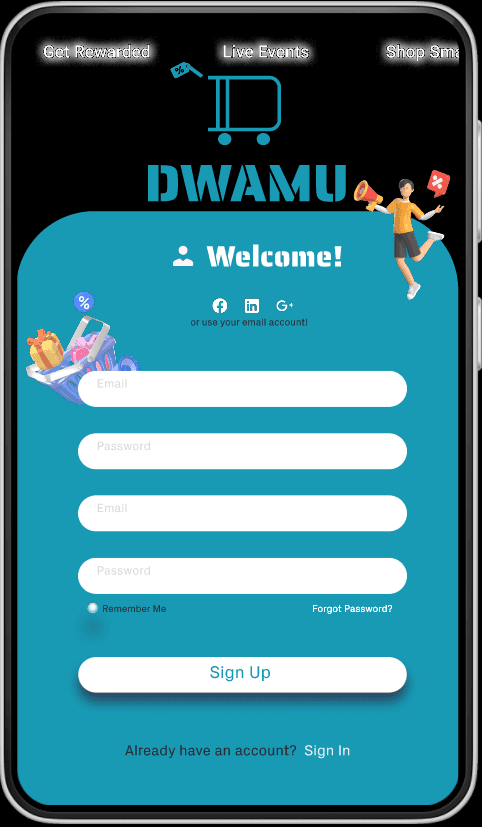
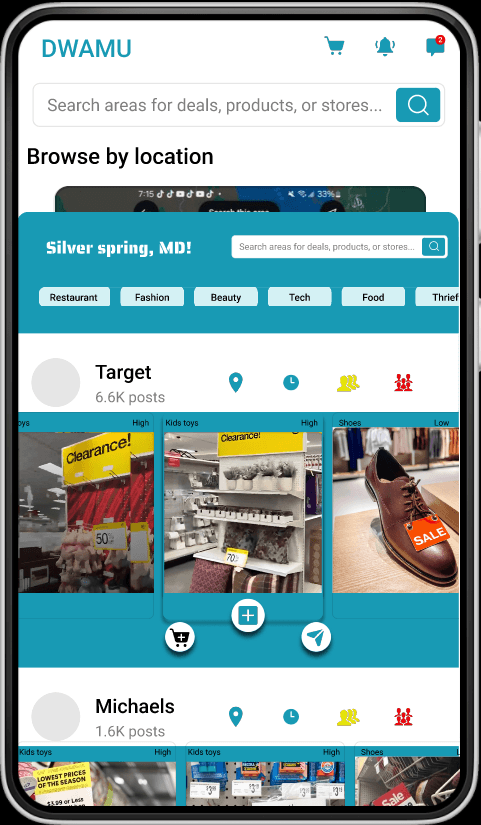
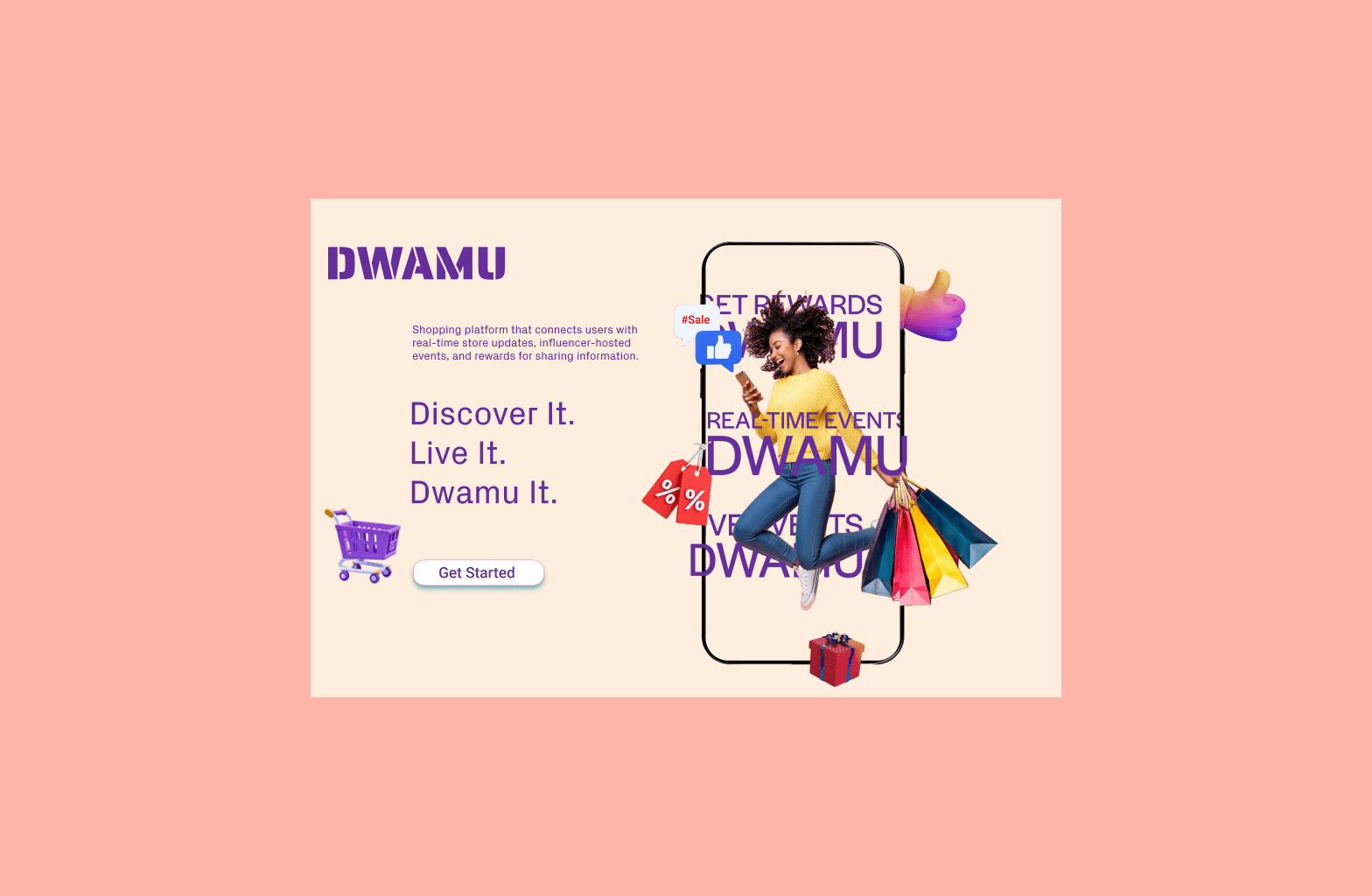
A mobile-first shopping assistant platform connecting users to real-time store data, influencer-hosted events, and gamified shopping experiences. I led branding and UX/UI design across mobile and web, shaping the shopper experience and developing a strategy-driven partner dashboard for retailers.
Industry
B2C / B2B2C Platform
Retail Technology
Social Commerce
Role
Product Designer
Responsibilities
UX/UI Design
Comparison analysis
Interaction & Flow Design
Content Strategy
Visual Design
Prototyping
Systems Thinking
Tools
Figma
Adobe Creative Suite
FigJam
Duration
December 16, 2024
to
Present
Project Overview
Dwamu was conceived as a data-driven, community-powered shopping platform designed to make retail experiences more efficient, engaging, and transparent. The goal was to create a unified system where real-time store insights, influencer content, and user contributions come together in one seamless experience. The platform needed to support multiple user groups; shoppers, influencers, and retailers, each with distinct goals and workflows, while maintaining clarity and ease of use across the experience. My role was to translate this vision into a structured product experience, defining intuitive flows, organizing complex information, and creating a system that feels simple despite its underlying complexity.
Who were the users?
Shoppers – Discover deals, check real-time store conditions, and make more efficient shopping decisions
Influencers – Host live shopping events, share recommendations, and drive engagement around products
Retailers / Partners – Manage store information, promote offers, and track customer engagement through data insights
Contributors (Community Users) – Submit updates on queue times, inventory, and store conditions while earning rewards
Features
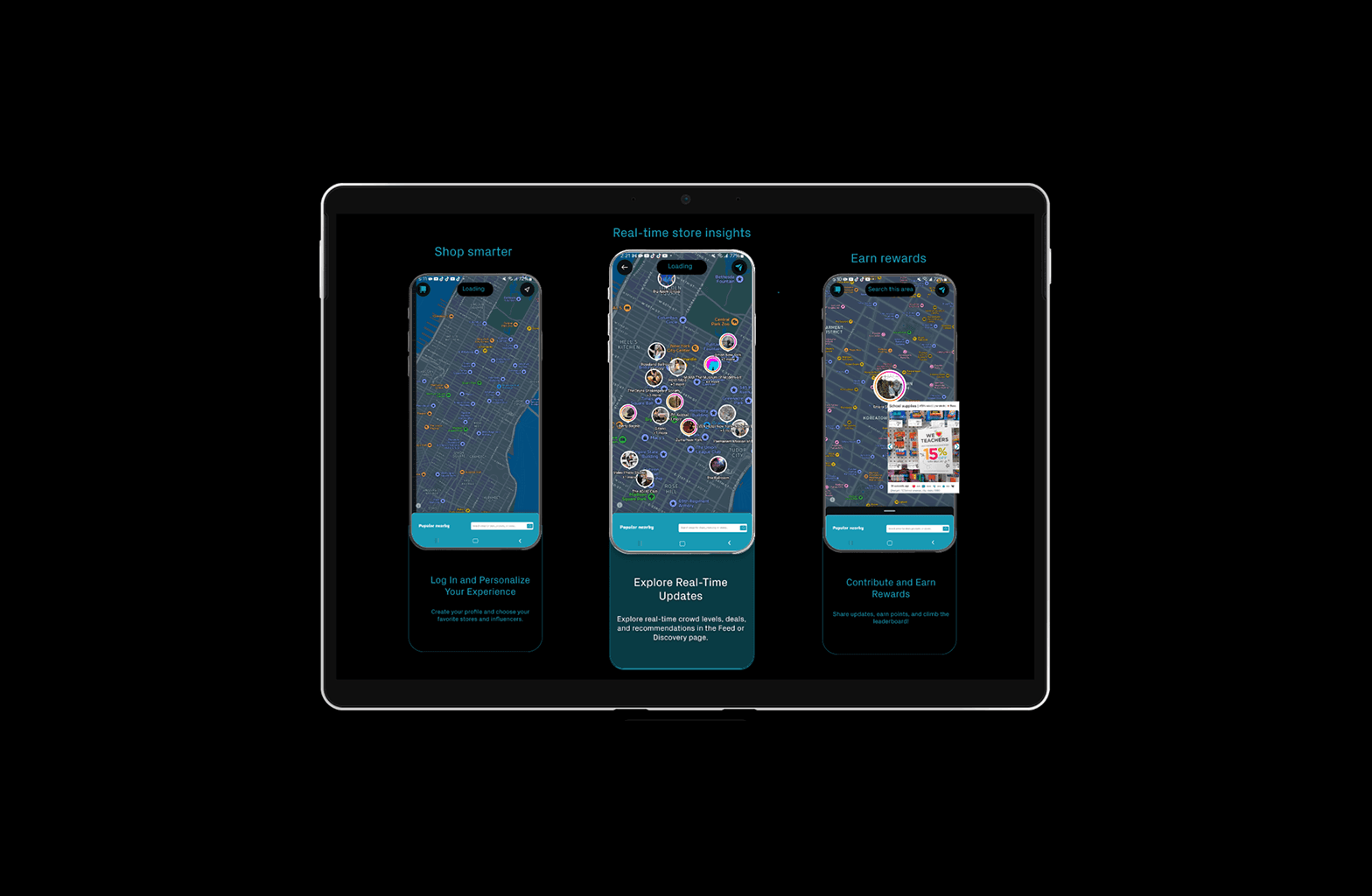
Real-time store insights (crowd levels, queue times, inventory availability)
Influencer-led shopping experiences with live events and product highlights
Interactive map and location-based discovery for nearby deals and stores
Community contributions with real-time updates and verification
Gamification system with points, badges, and leaderboards
Retailer dashboard for promotions, analytics, and store management

Project Goals
The primary goal was to design a platform that could support a complex, multi-role shopping ecosystem while remaining intuitive, engaging, and scalable. The experience needed to make real-time data, influencer content, and community contributions feel clear and actionable for users with varying levels of familiarity and technical confidence.
Design Thinking Process
Design thinking is a hands-on, user-centered approach to problem solving that emphasizes understanding real user needs, exploring ideas through iteration, and refining solutions through feedback. This approach encourages innovation, helps uncover meaningful opportunities, and supports building experiences that are both intuitive and impactful. The design-thinking process is typically structured into five key phases: Empathize, Define, Ideate, Prototype, and Test, providing a flexible framework for navigating complex and evolving design challenges.
Empathize

Define

Ideate

Prototype

Test

Empathize
The empathize phase focuses on developing a deep understanding of users : their needs, motivations, behaviors, and challenges, to ensure solutions are grounded in real human experiences.
User Research: Gather qualitative and quantitative insights through interviews, observations, and stakeholder discussions.
Dwamu: Engaged with stakeholders and potential users to understand shopping behaviors, real-time decision-making, and interactions with data and influencer content.
User Personas: Define representative user profiles to capture distinct goals and behaviors.
Dwamu: Developed personas for shoppers, influencers, retailers, and contributors to define role-specific goals and engagement patterns.
Empathy Mapping: Explore what users think, feel, say, and do to better understand emotional drivers.
Dwamu: Mapped user needs around efficiency, trust, engagement, and motivation to contribute.
Journey Mapping: Visualize user interactions over time to identify pain points and opportunities.
Dwamu: Outlined flows for discovering deals, engaging with content, and contributing updates to identify friction and opportunities.
Define
The define phase focuses on synthesizing user insights into a clear understanding of what problem the design should solve. This step reframes research findings into focused, actionable problem statements that guide ideation and decision-making.
Problem Statement: Summarize the core challenge from the user’s perspective.
Dwamu: Define how to design a single platform that combines real-time store data, influencer content, and community contributions without overwhelming users.
Point of View (POV): Frame the problem into a specific, human-centered perspective.
Dwamu: A multi-role shopping platform must make real-time data, social engagement, and contributions easy to understand and act on for users with varying needs and behaviors.
How Might We (HMW) Questions: Generate opportunity-driven questions that inspire creative exploration.
Dwamu:
How might we help users quickly find reliable, real-time store information?
How might we make influencer content feel useful within the shopping experience?
How might we encourage users to contribute updates in a simple and rewarding way?
How might we build trust in community-driven data?
Constraints & Considerations: Identify technical, business, and logistical limitations that shape the solution.
Dwamu:
Balancing real-time data accuracy with user-generated contributions
Integrating multiple features (data, content, gamification) without clutter
Designing for fast, on-the-go mobile interactions
Building a scalable system that supports multiple user roles and future growth
Ideate
The ideate phase focuses on exploring a wide range of possible solutions. This is where ideas are generated, challenged, and refined before committing to a specific direction.
Brainstorming: Generate diverse ideas without immediate constraints.
Dwamu: Collaborated with stakeholders to explore how real-time data, influencer content, and community contributions could work together in one cohesive experience.
Sketching & Wireframing: Translate ideas into rough visual concepts to explore layout and interaction directions.
Dwamu: Created early sketches and low-fidelity concepts to test map views, store detail layouts, and content integration patterns.
Divergent Thinking: Challenge assumptions and explore unconventional approaches.
Dwamu: Explored multiple ways to surface real-time data, integrate influencer content, and motivate user contributions before selecting a direction.
Collaboration: Work with stakeholders to expand, combine, and refine ideas before selecting directions to prototype.
Dwamu: Worked closely with stakeholders to refine concepts, balance feature priorities, and align on a scalable product direction.
Prototype
The prototype phase focuses on bringing ideas to life through tangible, testable representations. By creating and iterating on prototypes, design concepts can be evaluated, refined, and validated before moving into development.
Low-Fidelity Prototypes: Create quick, rough representations to explore layout, structure, and flow without heavy visual detail.
Dwamu: Created early wireframes to test map interactions, store detail layouts, and how real-time data, content, and contributions could be structured.
High-Fidelity Prototypes: Develop polished, interactive designs that closely resemble the final product experience.
Dwamu: Built interactive Figma prototypes for key experiences including the home/map view, store detail pages, influencer content, and contribution flows.
Iterative Prototyping: Refine prototypes continuously based on feedback from users and stakeholders.
Dwamu: Refined layouts, hierarchy, and interactions based on feedback to improve clarity, usability, and engagement.
Iterative Prototyping: Deliver a detailed, realistic prototype to align stakeholders and guide engineering implementation.
Dwamu: Delivered polished, clickable prototypes and supporting design components to align stakeholders and prepare for development.
Test
The test phase focuses on evaluating prototypes with users and stakeholders to identify usability issues, validate assumptions, and refine solutions. Testing ensures the design meets real user needs before moving into development.
Usability Testing: Observe users interacting with prototypes to identify friction points and confusion.
Dwamu: Conducted walkthroughs of prototypes to evaluate navigation clarity, real-time data visibility, and ease of contributing updates.
Feedback Collection: Gather input from users and stakeholders to assess clarity, functionality, and experience.
Dwamu: Collected feedback on map usability, store detail clarity, and the integration of influencer content and gamification elements.
Refinement & Iteration: Improve designs based on testing insights.
Dwamu: Simplified layouts, improved data hierarchy, and refined contribution flows to reduce friction and improve engagement.
Validation of Solutions: Confirm that proposed solutions effectively address the defined problem.
Dwamu: Validated that users could quickly find relevant store information, engage with content, and contribute updates with minimal effort.
Constrains and Challenges
Designing a data-driven, multi-role platform that combines real-time information, influencer content, and community contributions introduced complexity, integration challenges, and evolving priorities. Below are key challenges encountered and how I addressed them through design decisions.
Challenge
Balancing multiple features, real-time data, influencer content, and gamification, risked creating a cluttered and overwhelming experience.
Solution
Focused on clear hierarchy, modular layouts, and progressive disclosure to keep the interface intuitive and scannable.
Challenge
Encouraging users to contribute updates while minimizing friction.
Solution
Simplified contribution flows and integrated gamification elements to make participation easy and motivating.
Challenge
Integrating influencer content into a utility-driven shopping experience without disrupting core tasks.
Solution
Structured content in a way that complements user intent, keeping discovery seamless without interrupting primary flows.
Challenge
Users needed to quickly trust and act on real-time, community-driven data.
Solution
Designed clear visual cues, validation patterns, and simplified data presentation to build trust and support quick decision-making.
Challenge
Solution
Supporting multiple user types, shoppers, influencers, and retailers, within one cohesive system.
[NEXT PROJECT]
Aboagye Ventures
View Project
Dwamu
BRANDING & MARKETING
UX/UI DESIGN
WEB DESIGN
CONTENT STRATEGY
A mobile-first shopping assistant platform connecting users to real-time store data, influencer-hosted events, and gamified shopping experiences. I led branding and UX/UI design across mobile and web, shaping the shopper experience and developing a strategy-driven partner dashboard for retailers.
Industry
B2C / B2B2C Platform
Retail Technology
Social Commerce
Role
Product Designer
Responsibilities
UX/UI Design
Comparison analysis
Interaction & Flow Design
Content Strategy
Visual Design
Prototyping
Systems Thinking
Tools
Figma
Adobe Creative Suite
FigJam
Duration
December 16, 2024
to
Present
Project Overview
Dwamu was conceived as a data-driven, community-powered shopping platform designed to make retail experiences more efficient, engaging, and transparent. The goal was to create a unified system where real-time store insights, influencer content, and user contributions come together in one seamless experience. The platform needed to support multiple user groups; shoppers, influencers, and retailers, each with distinct goals and workflows, while maintaining clarity and ease of use across the experience. My role was to translate this vision into a structured product experience, defining intuitive flows, organizing complex information, and creating a system that feels simple despite its underlying complexity.
Who were the users?
Shoppers – Discover deals, check real-time store conditions, and make more efficient shopping decisions
Influencers – Host live shopping events, share recommendations, and drive engagement around products
Retailers / Partners – Manage store information, promote offers, and track customer engagement through data insights
Contributors (Community Users) – Submit updates on queue times, inventory, and store conditions while earning rewards
Features
Real-time store insights (crowd levels, queue times, inventory availability)
Influencer-led shopping experiences with live events and product highlights
Interactive map and location-based discovery for nearby deals and stores
Community contributions with real-time updates and verification
Gamification system with points, badges, and leaderboards
Retailer dashboard for promotions, analytics, and store management
Project Goals
The primary goal was to design a platform that could support a complex, multi-role shopping ecosystem while remaining intuitive, engaging, and scalable. The experience needed to make real-time data, influencer content, and community contributions feel clear and actionable for users with varying levels of familiarity and technical confidence.
Design Thinking Process
Design thinking is a hands-on, user-centered approach to problem solving that emphasizes understanding real user needs, exploring ideas through iteration, and refining solutions through feedback. This approach encourages innovation, helps uncover meaningful opportunities, and supports building experiences that are both intuitive and impactful. The design-thinking process is typically structured into five key phases: Empathize, Define, Ideate, Prototype, and Test, providing a flexible framework for navigating complex and evolving design challenges.
Empathize
Define
Ideate
Prototype
Test
Empathize
The empathize phase focuses on developing a deep understanding of users : their needs, motivations, behaviors, and challenges, to ensure solutions are grounded in real human experiences.
User Research: Gather qualitative and quantitative insights through interviews, observations, and stakeholder discussions.
Dwamu: Engaged with stakeholders and potential users to understand shopping behaviors, real-time decision-making, and interactions with data and influencer content.
User Personas: Define representative user profiles to capture distinct goals and behaviors.
Dwamu: Developed personas for shoppers, influencers, retailers, and contributors to define role-specific goals and engagement patterns.
Empathy Mapping: Explore what users think, feel, say, and do to better understand emotional drivers.
Dwamu: Mapped user needs around efficiency, trust, engagement, and motivation to contribute.
Journey Mapping: Visualize user interactions over time to identify pain points and opportunities.
Dwamu: Outlined flows for discovering deals, engaging with content, and contributing updates to identify friction and opportunities.
Define
The define phase focuses on synthesizing user insights into a clear understanding of what problem the design should solve. This step reframes research findings into focused, actionable problem statements that guide ideation and decision-making.
Problem Statement: Summarize the core challenge from the user’s perspective.
Dwamu: Define how to design a single platform that combines real-time store data, influencer content, and community contributions without overwhelming users.
Point of View (POV): Frame the problem into a specific, human-centered perspective.
Dwamu: A multi-role shopping platform must make real-time data, social engagement, and contributions easy to understand and act on for users with varying needs and behaviors.
How Might We (HMW) Questions: Generate opportunity-driven questions that inspire creative exploration.
Dwamu:
How might we help users quickly find reliable, real-time store information?
How might we make influencer content feel useful within the shopping experience?
How might we encourage users to contribute updates in a simple and rewarding way?
How might we build trust in community-driven data?
Constraints & Considerations: Identify technical, business, and logistical limitations that shape the solution.
Dwamu:
Balancing real-time data accuracy with user-generated contributions
Integrating multiple features (data, content, gamification) without clutter
Designing for fast, on-the-go mobile interactions
Building a scalable system that supports multiple user roles and future growth
Ideate
The ideate phase focuses on exploring a wide range of possible solutions. This is where ideas are generated, challenged, and refined before committing to a specific direction.
Brainstorming: Generate diverse ideas without immediate constraints.
Dwamu: Collaborated with stakeholders to explore how real-time data, influencer content, and community contributions could work together in one cohesive experience.
Sketching & Wireframing: Translate ideas into rough visual concepts to explore layout and interaction directions.
Dwamu: Created early sketches and low-fidelity concepts to test map views, store detail layouts, and content integration patterns.
Divergent Thinking: Challenge assumptions and explore unconventional approaches.
Dwamu: Explored multiple ways to surface real-time data, integrate influencer content, and motivate user contributions before selecting a direction.
Collaboration: Work with stakeholders to expand, combine, and refine ideas before selecting directions to prototype.
Dwamu: Worked closely with stakeholders to refine concepts, balance feature priorities, and align on a scalable product direction.
Prototype
The prototype phase focuses on bringing ideas to life through tangible, testable representations. By creating and iterating on prototypes, design concepts can be evaluated, refined, and validated before moving into development.
Low-Fidelity Prototypes: Create quick, rough representations to explore layout, structure, and flow without heavy visual detail.
Dwamu: Created early wireframes to test map interactions, store detail layouts, and how real-time data, content, and contributions could be structured.
High-Fidelity Prototypes: Develop polished, interactive designs that closely resemble the final product experience.
Dwamu: Built interactive Figma prototypes for key experiences including the home/map view, store detail pages, influencer content, and contribution flows.
Iterative Prototyping: Refine prototypes continuously based on feedback from users and stakeholders.
Dwamu: Refined layouts, hierarchy, and interactions based on feedback to improve clarity, usability, and engagement.
Iterative Prototyping: Deliver a detailed, realistic prototype to align stakeholders and guide engineering implementation.
Dwamu: Delivered polished, clickable prototypes and supporting design components to align stakeholders and prepare for development.
Test
The test phase focuses on evaluating prototypes with users and stakeholders to identify usability issues, validate assumptions, and refine solutions. Testing ensures the design meets real user needs before moving into development.
Usability Testing: Observe users interacting with prototypes to identify friction points and confusion.
Dwamu: Conducted walkthroughs of prototypes to evaluate navigation clarity, real-time data visibility, and ease of contributing updates.
Feedback Collection: Gather input from users and stakeholders to assess clarity, functionality, and experience.
Dwamu: Collected feedback on map usability, store detail clarity, and the integration of influencer content and gamification elements.
Refinement & Iteration: Improve designs based on testing insights.
Dwamu: Simplified layouts, improved data hierarchy, and refined contribution flows to reduce friction and improve engagement.
Validation of Solutions: Confirm that proposed solutions effectively address the defined problem.
Dwamu: Validated that users could quickly find relevant store information, engage with content, and contribute updates with minimal effort.
Constrains and Challenges
Designing a data-driven, multi-role platform that combines real-time information, influencer content, and community contributions introduced complexity, integration challenges, and evolving priorities. Below are key challenges encountered and how I addressed them through design decisions.
Challenge
Balancing multiple features, real-time data, influencer content, and gamification, risked creating a cluttered and overwhelming experience.
Solution
Focused on clear hierarchy, modular layouts, and progressive disclosure to keep the interface intuitive and scannable.
Challenge
Encouraging users to contribute updates while minimizing friction.
Solution
Simplified contribution flows and integrated gamification elements to make participation easy and motivating.
Challenge
Integrating influencer content into a utility-driven shopping experience without disrupting core tasks.
Solution
Structured content in a way that complements user intent, keeping discovery seamless without interrupting primary flows.
Challenge
Users needed to quickly trust and act on real-time, community-driven data.
Solution
Designed clear visual cues, validation patterns, and simplified data presentation to build trust and support quick decision-making.
Challenge
Solution
Supporting multiple user types, shoppers, influencers, and retailers, within one cohesive system.
[NEXT PROJECT]
Aboagye Ventures
View Project
Dwamu
BRANDING & MARKETING
UX/UI DESIGN
WEB DESIGN
CONTENT STRATEGY
A mobile-first shopping assistant platform connecting users to real-time store data, influencer-hosted events, and gamified shopping experiences. I led branding and UX/UI design across mobile and web, shaping the shopper experience and developing a strategy-driven partner dashboard for retailers.
Industry
B2C / B2B2C Platform
Retail Technology
Social Commerce
Role
Product Designer
Responsibilities
UX/UI Design
Comparison analysis
Interaction & Flow Design
Content Strategy
Visual Design
Prototyping
Systems Thinking
Tools
Figma
Adobe Creative Suite
FigJam
Duration
December 16, 2024
to
Present
Project Overview
Dwamu was conceived as a data-driven, community-powered shopping platform designed to make retail experiences more efficient, engaging, and transparent. The goal was to create a unified system where real-time store insights, influencer content, and user contributions come together in one seamless experience. The platform needed to support multiple user groups; shoppers, influencers, and retailers, each with distinct goals and workflows, while maintaining clarity and ease of use across the experience. My role was to translate this vision into a structured product experience, defining intuitive flows, organizing complex information, and creating a system that feels simple despite its underlying complexity.
Who were the users?
Shoppers – Discover deals, check real-time store conditions, and make more efficient shopping decisions
Influencers – Host live shopping events, share recommendations, and drive engagement around products
Retailers / Partners – Manage store information, promote offers, and track customer engagement through data insights
Contributors (Community Users) – Submit updates on queue times, inventory, and store conditions while earning rewards
Features
Real-time store insights (crowd levels, queue times, inventory availability)
Influencer-led shopping experiences with live events and product highlights
Interactive map and location-based discovery for nearby deals and stores
Community contributions with real-time updates and verification
Gamification system with points, badges, and leaderboards
Retailer dashboard for promotions, analytics, and store management
Project Goals
The primary goal was to design a platform that could support a complex, multi-role shopping ecosystem while remaining intuitive, engaging, and scalable. The experience needed to make real-time data, influencer content, and community contributions feel clear and actionable for users with varying levels of familiarity and technical confidence.
Design Thinking Process
Design thinking is a hands-on, user-centered approach to problem solving that emphasizes understanding real user needs, exploring ideas through iteration, and refining solutions through feedback. This approach encourages innovation, helps uncover meaningful opportunities, and supports building experiences that are both intuitive and impactful. The design-thinking process is typically structured into five key phases: Empathize, Define, Ideate, Prototype, and Test, providing a flexible framework for navigating complex and evolving design challenges.
Empathize
Define
Ideate
Prototype
Test
Empathize
The empathize phase focuses on developing a deep understanding of users : their needs, motivations, behaviors, and challenges, to ensure solutions are grounded in real human experiences.
User Research: Gather qualitative and quantitative insights through interviews, observations, and stakeholder discussions.
Dwamu: Engaged with stakeholders and potential users to understand shopping behaviors, real-time decision-making, and interactions with data and influencer content.
User Personas: Define representative user profiles to capture distinct goals and behaviors.
Dwamu: Developed personas for shoppers, influencers, retailers, and contributors to define role-specific goals and engagement patterns.
Empathy Mapping: Explore what users think, feel, say, and do to better understand emotional drivers.
Dwamu: Mapped user needs around efficiency, trust, engagement, and motivation to contribute.
Journey Mapping: Visualize user interactions over time to identify pain points and opportunities.
Dwamu: Outlined flows for discovering deals, engaging with content, and contributing updates to identify friction and opportunities.
Define
The define phase focuses on synthesizing user insights into a clear understanding of what problem the design should solve. This step reframes research findings into focused, actionable problem statements that guide ideation and decision-making.
Problem Statement: Summarize the core challenge from the user’s perspective.
Dwamu: Define how to design a single platform that combines real-time store data, influencer content, and community contributions without overwhelming users.
Point of View (POV): Frame the problem into a specific, human-centered perspective.
Dwamu: A multi-role shopping platform must make real-time data, social engagement, and contributions easy to understand and act on for users with varying needs and behaviors.
How Might We (HMW) Questions: Generate opportunity-driven questions that inspire creative exploration.
Dwamu:
How might we help users quickly find reliable, real-time store information?
How might we make influencer content feel useful within the shopping experience?
How might we encourage users to contribute updates in a simple and rewarding way?
How might we build trust in community-driven data?
Constraints & Considerations: Identify technical, business, and logistical limitations that shape the solution.
Dwamu:
Balancing real-time data accuracy with user-generated contributions
Integrating multiple features (data, content, gamification) without clutter
Designing for fast, on-the-go mobile interactions
Building a scalable system that supports multiple user roles and future growth
Ideate
The ideate phase focuses on exploring a wide range of possible solutions. This is where ideas are generated, challenged, and refined before committing to a specific direction.
Brainstorming: Generate diverse ideas without immediate constraints.
Dwamu: Collaborated with stakeholders to explore how real-time data, influencer content, and community contributions could work together in one cohesive experience.
Sketching & Wireframing: Translate ideas into rough visual concepts to explore layout and interaction directions.
Dwamu: Created early sketches and low-fidelity concepts to test map views, store detail layouts, and content integration patterns.
Divergent Thinking: Challenge assumptions and explore unconventional approaches.
Dwamu: Explored multiple ways to surface real-time data, integrate influencer content, and motivate user contributions before selecting a direction.
Collaboration: Work with stakeholders to expand, combine, and refine ideas before selecting directions to prototype.
Dwamu: Worked closely with stakeholders to refine concepts, balance feature priorities, and align on a scalable product direction.
Prototype
The prototype phase focuses on bringing ideas to life through tangible, testable representations. By creating and iterating on prototypes, design concepts can be evaluated, refined, and validated before moving into development.
Low-Fidelity Prototypes: Create quick, rough representations to explore layout, structure, and flow without heavy visual detail.
Dwamu: Created early wireframes to test map interactions, store detail layouts, and how real-time data, content, and contributions could be structured.
High-Fidelity Prototypes: Develop polished, interactive designs that closely resemble the final product experience.
Dwamu: Built interactive Figma prototypes for key experiences including the home/map view, store detail pages, influencer content, and contribution flows.
Iterative Prototyping: Refine prototypes continuously based on feedback from users and stakeholders.
Dwamu: Refined layouts, hierarchy, and interactions based on feedback to improve clarity, usability, and engagement.
Iterative Prototyping: Deliver a detailed, realistic prototype to align stakeholders and guide engineering implementation.
Dwamu: Delivered polished, clickable prototypes and supporting design components to align stakeholders and prepare for development.
Test
The test phase focuses on evaluating prototypes with users and stakeholders to identify usability issues, validate assumptions, and refine solutions. Testing ensures the design meets real user needs before moving into development.
Usability Testing: Observe users interacting with prototypes to identify friction points and confusion.
Dwamu: Conducted walkthroughs of prototypes to evaluate navigation clarity, real-time data visibility, and ease of contributing updates.
Feedback Collection: Gather input from users and stakeholders to assess clarity, functionality, and experience.
Dwamu: Collected feedback on map usability, store detail clarity, and the integration of influencer content and gamification elements.
Refinement & Iteration: Improve designs based on testing insights.
Dwamu: Simplified layouts, improved data hierarchy, and refined contribution flows to reduce friction and improve engagement.
Validation of Solutions: Confirm that proposed solutions effectively address the defined problem.
Dwamu: Validated that users could quickly find relevant store information, engage with content, and contribute updates with minimal effort.
Constrains and Challenges
Designing a data-driven, multi-role platform that combines real-time information, influencer content, and community contributions introduced complexity, integration challenges, and evolving priorities. Below are key challenges encountered and how I addressed them through design decisions.
Challenge
Balancing multiple features, real-time data, influencer content, and gamification, risked creating a cluttered and overwhelming experience.
Solution
Focused on clear hierarchy, modular layouts, and progressive disclosure to keep the interface intuitive and scannable.
Challenge
Encouraging users to contribute updates while minimizing friction.
Solution
Simplified contribution flows and integrated gamification elements to make participation easy and motivating.
Challenge
Integrating influencer content into a utility-driven shopping experience without disrupting core tasks.
Solution
Structured content in a way that complements user intent, keeping discovery seamless without interrupting primary flows.
Challenge
Users needed to quickly trust and act on real-time, community-driven data.
Solution
Designed clear visual cues, validation patterns, and simplified data presentation to build trust and support quick decision-making.
Challenge
Solution
Supporting multiple user types, shoppers, influencers, and retailers, within one cohesive system.
[NEXT PROJECT]
Aboagye Ventures
View Project